

History and use of the UNITAS 6498 watch movement
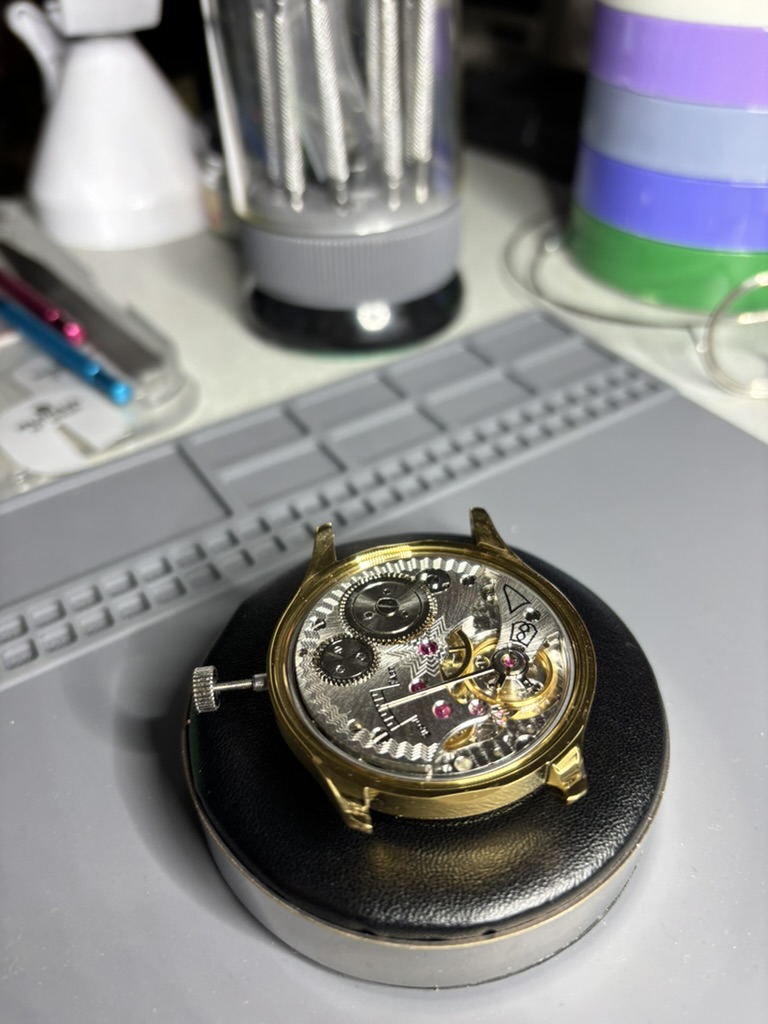
History of UNITAS 6498
The UNITAS 6498 movement was developed in the 1950s (around 1950) by the Swiss manufacturer Unitas, which later became part of the ETA group (today part of Swatch Group). It is a manual-wind movement of 16½ ligne size (approximately 36.6 mm in diameter) and about 4.5 mm thick.
The 6498 is a Savonette (or hunter) type variant, meaning:
- Crown at the 3 o’clock position
- Small seconds at the 6 o’clock position (90° offset from the vertical axis)
Its “twin” is the 6497 (Lépine type), where the crown is at 12 o’clock and the small seconds at 6 o’clock — this one is more common in wristwatches today.
The movement was originally intended for pocket watches, but proved extremely robust, reliable and easy to regulate (capable of achieving chronometer accuracy). It typically has 17 jewels (some older models 15), a frequency of 18,000 A/h (later 21,600 A/h in -2 versions) and a power reserve of around 46–50 hours (depending on version).
In 1967, ETA took over and modernized the movement → ETA 6498-1, later 6498-2 (with higher frequency of 21,600 A/h and some minor improvements such as the Etachron regulator).
In the 1990s it became very popular due to the large watch trend — mainly thanks to Panerai, which used the related 6497 for their Luminor models (the 6498 appears less frequently in premium brands).
Today, the 6498 (and 6497) is one of the most important teaching movements in watchmaking schools — simple, transparent, and very suitable for learning the basics of horology.
Modern use of original UNITAS / ETA 6498
- Still in production (ETA 6498-2)
- Used by independent manufacturers, micro brands and some higher segments (e.g. modifications by Tourby, Torsti Laine, some limited series by Sinn, Eberhard, Maurice Lacroix, Wempe etc.)
- Often used as a base for highly decorated, skeletonized or modified versions (adding power reserve, retrograde date etc.)
- Remains a “workhorse” — reliable, cheap to maintain, easy to service
Clones — especially Seagull ST36 / ST3620
The most well-known and widespread clone is the Chinese Seagull ST36 (often labeled as ST3620 for the 6498 configuration or ST3600 for the 6497 configuration).
- Seagull (Tianjin Seagull) began producing very accurate copies in the 2000s
- The ST36/ST3620 is an almost identical copy of the ETA 6498-2 (21,600 A/h, Savonette layout)
- Price: original ETA ~€150–250, Seagull ST36/ST3620 only €30–60 (hence extremely popular with micro brands, custom builders, modders and horology beginners)
- Power reserve on the Seagull is often even somewhat higher (around 55–58 hours)
- Accuracy after service can achieve very good values (±5–15 s/day), but the original ETA has better materials, tolerances and longevity
Differences between original and clone
- Better surface finishing, tighter tolerances and better metals in the ETA
- The Seagull is excellent for the price — after service it performs surprisingly well and has become the standard for affordable mechanical watches on AliExpress/eBay, custom watches, homage models and learning purposes
Key specifications comparison
| Specification | ETA / Unitas 6498-2 | Seagull ST36 / ST3620 |
|---|---|---|
| Diameter | 36.6 mm | 36.6 mm |
| Height | ~4.5 mm | ~4.5–4.8 mm |
| Frequency | 21,600 A/h | 21,600 A/h |
| Power reserve | 46–51 hours | 55–58 hours (often) |
| Jewels | 17 | 17 |
| Regulator | Etachron (modern versions) | Usually swan neck or similar |
| Price (approx.) | €150–300 | €30–60 |
| Typical use | premium, modifications | micro brands, custom, learning |
Conclusion
The UNITAS 6498 is a classic “eternal” movement — from the 1950s, yet still very much alive today. From pocket watches, through Panerai’s large watch boom, to today’s custom and micro brands. Chinese clones like the Seagull ST36/ST3620 have breathed new life into it — enabling mechanical watches under €200 that are accessible to everyone, while preserving the classic design and reliability.